
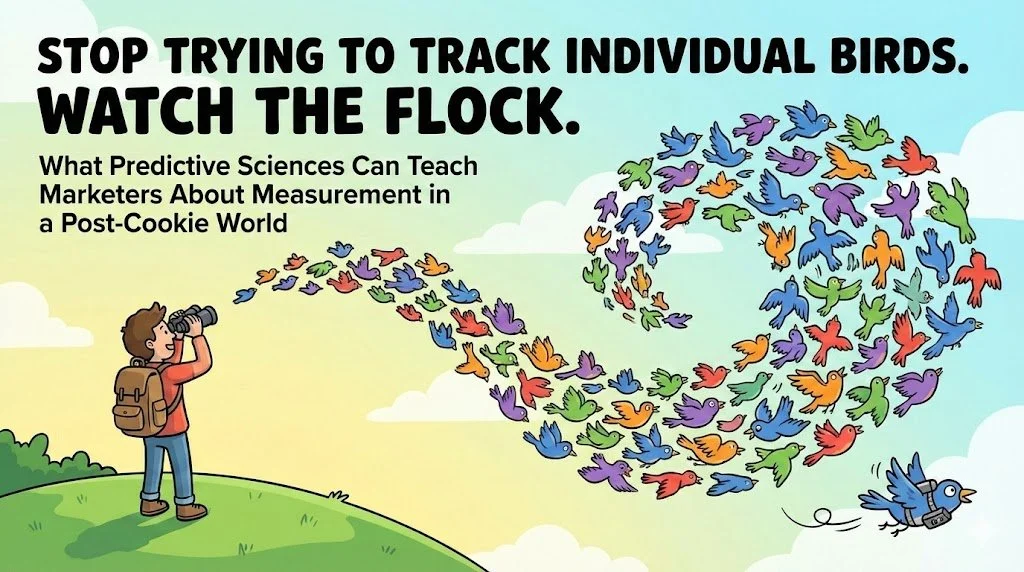
Stop Trying to Track Individual Birds. Watch the Flock.
“We couldn’t measure the relative impact of the million dollars we just dumped into influencers.”
“It’s fine, but we can’t see how our ads on all those podcasts are affecting things.”
“Our clients are almost always a combo of at least two people, if not more, and the purchase path is online, in-store, and over months. The attribution didn’t do anything for us.”
“We get the report every few months, I stopped looking at it. It’s a waste of money.”
I’ve heard so much of this and things like it the past several months as I’ve been chatting with people about attribution and marketing measurement. I would say that the general feeling right now about “attribution” falls into categories like:
It’s Dead
It’s Useless
It’s Expensive and Useless
Don’t worry about sounding professional. Sound like you. There are over 1.5 billion websites out there, but your story is what’s going to separate this one from the rest. If you read the words back and don’t hear your own voice in your head, that’s a good sign you still have more work to do.
Be clear, be confident and don’t overthink it. The beauty of your story is that it’s going to continue to evolve and your site can evolve with it. Your goal should be to make it feel right for right now. Later will take care of itself. It always does.
One of the reasons is that people just can’t seem to quit cookies. Or at least the idea of them.
I remember the first time that I saw “Data Driven Attribution” in Google Analytics. You could choose the model, and compare it to things like Last Click or some Rules Based method like Linear or Time Decay… Of course it had major flaws as soon as it hit. It couldn’t do cross-device, or god forbid multi-user attribution. It didn’t see offline or traditional marketing. And what was there was already just a fraction of the actual data (75% or more even back then depending on the vertical would get blocked, and it had a TON of “direct” traffic which really meant “we don’t know where it came from” traffic.
The concept of tagging and following a specific person was always highly flawed, but it was all we had. Now, it’s at best sputtering out blood and asking to see its mother.
The reality is that people just don’t trust an attribution model that requires cookies, even if they don’t know it’s because it’s a cookie reliant model.
Stop Tracking Birds…
Start Tracking the Flock
The reality is we need to stop tracking birds, and start measuring the entire flock.
Watch a flock of birds swarming around, and then try and watch an individual bird. First you’re going to have trouble keeping an eye on that specific bird, you’ll see only parts of its flight. Second, when you do see it, notice how frequently it individually isn’t actually headed in the same direction the front of the flock is.
Individually we humans can be pretty chaotic, but collectively, it’s similar to the flock of birds. Get enough data on enough humans, and the signal emerges from the noise. Trying to understand marketing performance by tracking individuals is like trying to predict where a flock of birds is heading by tagging a single bird.
Every field that studies complex human or natural systems (traffic engineering, stadium crowd management, weather forecasting, epidemiology) all discovered the same thing decades ago. You don’t predict complex systems by tracking individuals, you measure the system as a whole. Every single field converged on the same solution: Use aggregated behavioral data and statistical modeling to understand how the system behaves.
It’s time for marketers to play catch-up.
The Problem With Tracking People
(Even When It “Works”)
Before we get into the actual science, I want to be sure to hammer on something again:
User-level tracking was ALWAYS a flawed idea. Cookies dying didn’t break some perfect idyllic system where marketers lived in the golden sunshine of truth. The death of the cookie broke a very fragile illusion.
Humans behave chaotically - Your “journey map” is a fantasy. People don’t behave linearly, and they never have. (check out Decoding Decisions, Making Sense of the Messy Middle)
Identity data is incomplete - Even before privacy changes, most journeys weren’t trackable; device switching, shared devices, offline touchpoints, dark social, podcasts, ctv, retail media, real world conversations, etc.
Even when IDs exist, they disagree - Platform A says the user is one person, but Platform B says they are someone else, and Platform C says “what person?”
Individual paths don’t scale - The more channels you add, the more brittle and misleading your user-level models become.
Individual journeys aren’t the point anyway - Human decision making isn’t dictated by touchpoint order. It emerges from context, momentum and overall collective behavior.
The funny thing is that even if we had PERFECT identity data, it still wouldn’t be able to give us the truth, because the truth lives at the population level.
Aggregated Behavioral Data: The Real Signal Marketers Have Been Missing
What do I mean by aggregated data? Aggregated data means that we stop asking “what did a specific user do?” and we start asking “what does the overall pattern of behavior look like?”
So things like:
Total impressions
Channel-level spend
Visits, clicks, conversions
Revenue
Lag effects
Seasonality
Cross-channel relationships
When you zoom out and look at the big flock of humans, the noise actually disappears, the overall pattern of the flock emerges, and the signal becomes obvious. This is how every other serious predictive science in the world works, and marketing should as well.
Traffic Science: Predicting Movement at Scale Without Tracking Drivers
Traffic engineers don’t know who’s in any given car. They don’t walk around the neighborhood throwing apple tags on as many cars as they can. They don’t care. They don’t need to do that. They use detectors that get laid on the road, radar sensors, and aggregated GPS data (not tied to identity) to measure flow, speed, traffic density, congestion patterns, etc.
Once they have all that aggregated data, they model the entire road system, not the individual drivers, using statistics.
Regression Models
A regression model finds relationships between two things, like how traffic volume changes with time of day or weather.
Time-Series Forecasting (ARIMA, SARIMA)
These models look at historical patterns to predict future congestion. SARIMA specifically is used to add “seasonality” which is how it knows that the highway is gonna be a beast during rush hour.
Queuing Theory
This was math that was developed to study queues and waiting lines. It’s used to predict how backups form at intersections or tolls.
There’s More Automata
Cellular Automata, the Nagel-Schreckenberg Model, Bayesian Updating, Math math math, Bayesian methods come up alot. Why? Because they:
incorporate uncertainty
handle missing data
update as new information arrives
estimate causal effects.
None of these models requires tracking individuals, because traffic is a system, not a collection of users
Marketing works the same way.
Crowd Dynamics: Predicting Human Movement Without Knowing Who Anyone Is
Stadium operators, airports, and large venues use a field called Crowd Science to predict how thousands of people will move. This is no laughing matter either, if you design these areas poorly, people can actually die. Once again, zero need for identity.
Whether they use overhead cameras (no facial recognition), density heatmaps, flow detection, pressure sensors, it doesn’t really matter. They track the flock, then apply models like Fluid Dynamics to predict bottlenecks. Stochastic Models are used to incorporate randomness. Social Force Models simulate humans as “particles” influenced by attractive and repulsive forces. Monte Carlo Simulations.
They don’t need to know who you are. They need to know how the crowd behaves as a unit. As a flock.
Again, this is the mindset that marketing needs.
Meteorology: The Most Accurate Analogy for Modern Marketing Modeling
Weather forecasting is one of the most sophisticated predictive systems ever created, and it relies almost entirely on aggregated data and Bayesian inference.
Numerical Weather Prediction (NWP), Ensemble Modeling, Kalman Filters, Bayesian Updating; Meterologists use massive physics based models to simulate and predict probabilities of different weather conditions. It’s fun to complain about a bad weather prediction, but meteorology is insanely chaotic, highly complex, and full of uncertainty… And yet we can predict outcomes with remarkable accuracy.
Marketing, with all its interconnected and noisy signals, is far closer to weather than to user-level tracking.
Epidemiology: The Closest Conceptual Cousin to Attribution
If you really want to understand attribution, look at disease modeling. Epidemiologists use population-level models like: SIR/SEIR Models, Bayesian Inference + Markov Chain Monte Carlo algorithms, Stochastic Modeling, and Agent-Based Models to simulate interactions (not actual tracked people).
The relevance of how epidemiologists use data, to marketing, is almost a 1 to 1.
Exposure leads to influence which leads to conversion is remarkably similar to exposure leads to infection, which leads to sickness.
It’s the same math.
So What Do All These Sciences Agree On?
Across traffic engineering, crowd science, meteorology, and epidemiology, the conclusions are basically identical:
Individual-level data is noisy, incomplete, and misleading.
The real truth is found in aggregated behavioral patterns.
Bayesian inference is the most powerful way to model complex systems.
Complex systems must be modeled holistically, not individually.
Predictive power emerges when you stop chasing “who did what” and start modeling “which forces shape behavior.”
We need to model probabilistic outcomes instead of providing false certainty This is where marketing measurement is finally, hopefully, headed.
What This Means for Marketers in 2026 and Beyond
Identity will continue to collapse.
Cookie deprecation, mobile tracking restrictions, privacy regulations, if you didn’t realize this years ago, the writing is on the wall. In blood at this point.
But that’s not the crisis many people think it is.
It’s an opportunity to shift to a measurement paradigm that actually works, as opposed to the mirage that we held before.
Attribution is moving from individuals to systems.
Not user-level trails, but system-level causal modeling is the future of attribution and marketing measurement.
Aggregated behavioral signals are the future.
Just like every mature scientific discipline already figured out.
Bayesian regression is the right tool for understanding what drives revenue.
It handles complexity the way the real world behaves.
This isn’t worse than the old way, it’s better.
In fact, it’s the first time marketing measurement can be scientifically trustworthy.
Stop Tagging Birds. Watch the Flock.
Marketers have been trying to solve a systems problem with an identity-based tool. It was never going to work. When you step back, and zoom out, and stop trying to tag every bird… you can watch the entire motion of the flock.
Every other predictive science figured this out decades ago.
Traffic scientists don’t track drivers.
Crowd scientists don’t track people.
Meteorologists don’t track molecules.
Epidemiologists don’t track every infected person.
And marketers don’t need to track individual users to understand what drives performance.
The future is simple:
Stop tagging birds.
Measure the flock.
Use the math that the rest of the scientific world already trusts.
